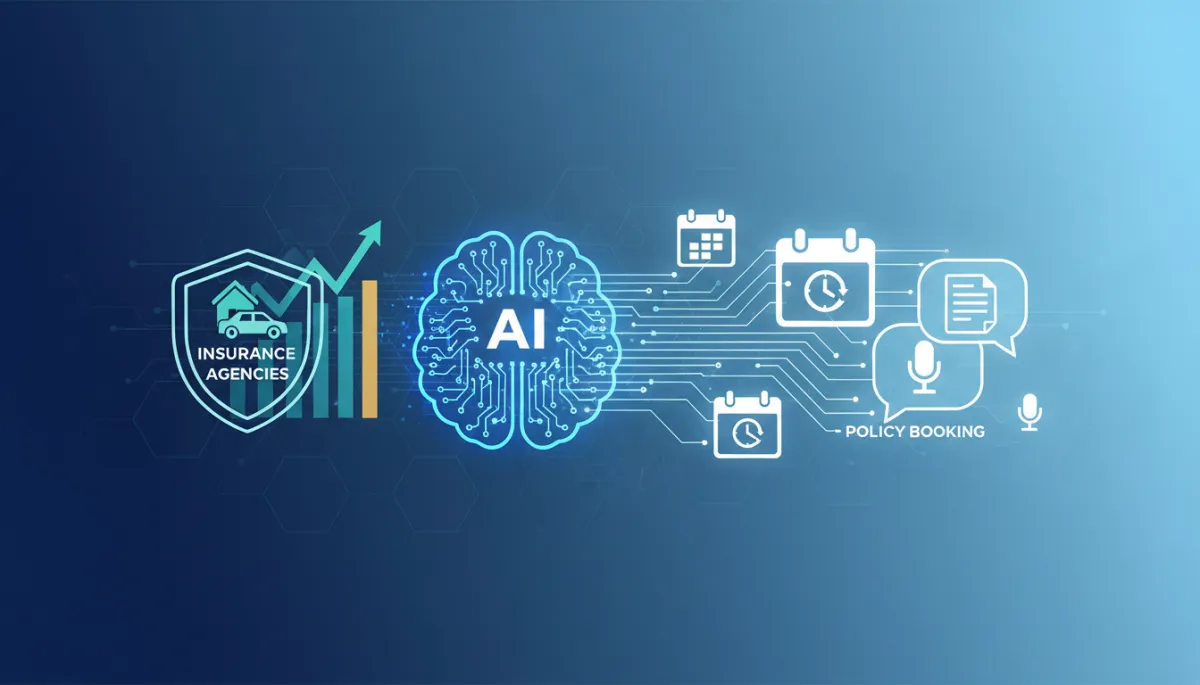
AI Appointment Setting for Insurance Agencies
AI, Insurance, Appointment Setting, Lead Management
AI Appointment Setting for Insurance Agencies: Follow Up Faster, Book More Policies
How insurance agencies can use AI appointment setting to accelerate follow-up, rescue more leads from the CRM, and give producers more time with qualified prospects.
Why Fast Follow-Up Is Non‑Negotiable in Insurance
Insurance leads are expensive—whether they come from paid inbound, referral campaigns, or old quote requests. In a competitive market where prospects are actively shopping, the agency that responds first, with clarity, usually controls the conversation. Industry-wide, AI-powered quoting and scheduling tools are already being used to respond instantly to inbound interest and route people into the right conversations (InsuranceConnectAI, 2026) .
Most agencies do not lose because they lack opportunity. They lose because follow-up breaks: leads arrive after hours, quote forms sit in inboxes, producers get busy, and older opportunities quietly rot in the CRM. By the time someone calls, the prospect has already spoken with two other agencies—or moved on entirely.
What AI Appointment Setting Actually Does for an Insurance Agency
From a systems perspective, AI appointment setting is a layer that sits between your lead sources and your producers. Instead of relying on humans to remember every follow-up, an AI agent orchestrates a consistent sequence of outreach, qualification, and scheduling across channels like SMS, email, and even voice. Tools such as Insurance Appointment Engine and Bizzby already automate multi-touch follow-up and calendar booking for agents, with a strong emphasis on speed and coverage of every lead touch (Insurance Appointment Engine) and (Bizzby) .
Instant response: A new quote request triggers an AI-driven reply within seconds, even after hours or on weekends.
Multi-attempt follow-up: The system continues outreach over days, not minutes, without relying on human memory or sticky notes.
Qualification: Prospects answer basic questions about policy type, timing, and current carrier so producers walk into calls prepared.
Routing and scheduling: Qualified leads get routed to the right team (personal, commercial, life, benefits) and offered calendar slots automatically.
Reminders and recovery: Automated reminders reduce no-shows, and missed appointments trigger follow-up to rebook.
💡 Pro Tip: Treat AI as your first-line SDR for insurance—its job is to protect every lead and hand producers clean, qualified conversations.
Improving Lead Handling: From Raw Inquiry to Booked Policy Conversation
A strong AI appointment setting workflow focuses on execution, not storage. Your CRM can hold contacts; an AI engine ensures those contacts are actually worked. Platforms like SchedulingKit show how automated booking, reminders, and calendar syncing can be layered on top of existing CRMs and agency management systems (SchedulingKit, 2026) .
As a senior engineer, I like to think in terms of events and state. A minimal event-driven flow for new leads might look like this in pseudocode using a background worker and webhooks:
import datetime as dt
from enum import Enum

class LeadStatus(Enum):
    NEW = "NEW"
    QUALIFYING = "QUALIFYING"
    QUALIFIED = "QUALIFIED"
    SCHEDULED = "SCHEDULED"
    CLOSED = "CLOSED"
    STALE = "STALE"


def handle_new_lead(lead):
    lead.status = LeadStatus.NEW
    save_lead(lead)

    # 1. Instant response
    send_ai_message(
        to=lead.phone,
        template="new_quote_ack",
        context={"first_name": lead.first_name}
    )

    # 2. Start qualification workflow
    enqueue_job("run_qualification_sequence", lead_id=lead.id)


def run_qualification_sequence(lead_id: str):
    lead = load_lead(lead_id)

    if lead.status in {LeadStatus.CLOSED, LeadStatus.STALE}:
        return

    lead.status = LeadStatus.QUALIFYING
    save_lead(lead)

    asked = ask_qualifying_questions(lead)

    if asked and lead.is_qualified():
        lead.status = LeadStatus.QUALIFIED
        save_lead(lead)
        offer_calendar_slots(lead)
    else:
        schedule_retry(lead_id, delay_minutes=30)
In practice, a system like Call Boss would encapsulate this logic behind APIs or workflow builders, but the principle is the same: every lead triggers a deterministic, trackable process instead of ad hoc human behavior.
The Hidden Value of Re‑Engaging Old Quote Requests
Most agencies have a silent asset: years of quote requests that never closed. Many of those prospects did not say “no forever”—they simply got busy, bought elsewhere temporarily, or never received consistent follow-up. Dedicated systems like Insurance Appointment Engine and Bizzby are explicitly built to reactivate these dormant records and convert them into fresh appointments through AI-driven SMS and messaging sequences.
From an engineering standpoint, reactivation is just a different trigger and audience. The logic can be simple:
def schedule_reactivation_campaign(days_since_last_contact: int = 90):
    stale_leads = find_leads(
        status_in=[LeadStatus.NEW, LeadStatus.QUALIFYING, LeadStatus.QUALIFIED],
        last_contact_before=dt.date.today() - dt.timedelta(days=days_since_last_contact)
    )

    for lead in stale_leads:
        enqueue_job("send_reactivation_sequence", lead_id=lead.id)


def send_reactivation_sequence(lead_id: str):
    lead = load_lead(lead_id)

    send_ai_message(
        to=lead.phone,
        template="reactivation_offer",
        context={
            "first_name": lead.first_name,
            "line_of_business": lead.line_of_business,
        }
    )

    # Optionally add an immediate booking link
    send_booking_link(lead)
When this type of campaign is paired with intelligent routing and eligibility checks—capabilities commonly seen in emerging “agentic AI” platforms (Zentrixsoft, 2026) —agencies can systematically mine their database for additional premium without overwhelming staff.
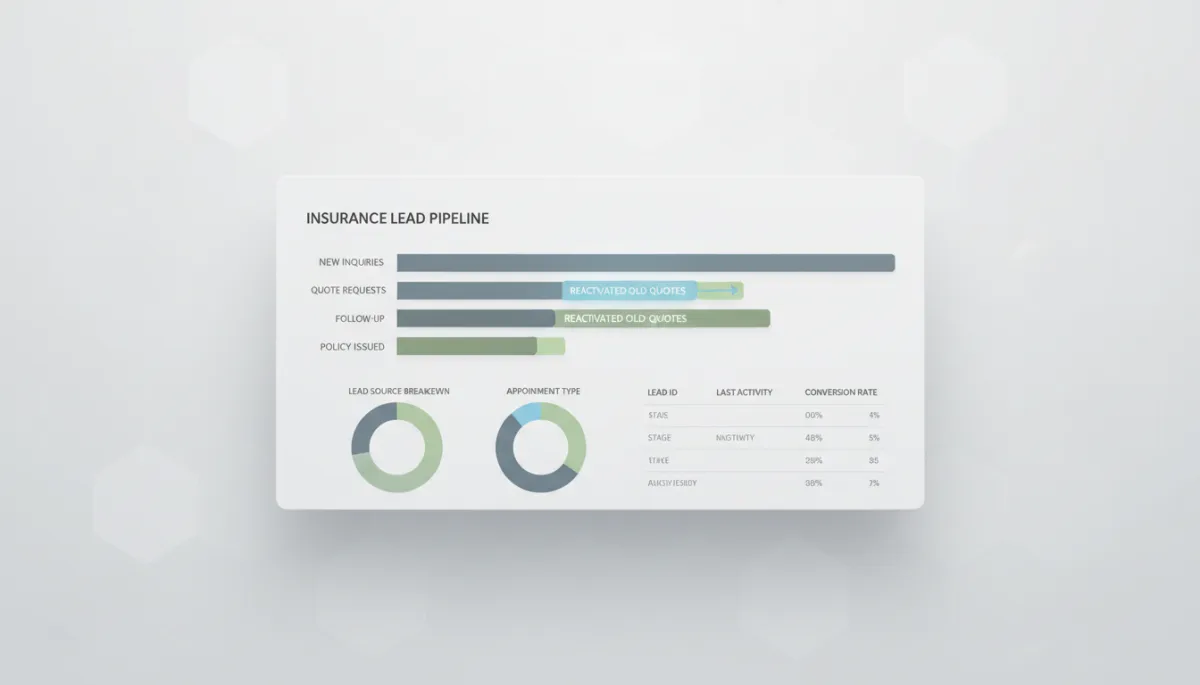
Reactivation campaigns often unlock premium from quote requests that were never truly lost.
A Practical Workflow for Insurance Follow‑Up with AI
A robust Call Boss–style workflow for insurance agencies should cover the full lifecycle from first touch to reactivation. At a high level, the architecture looks like this:
Instant inbound response: Web forms, landing pages, and call tracking numbers all feed into a central intake API. AI acknowledges the request immediately and starts qualification.
Qualification logic: Rules branch by line of business (auto, home, commercial, life), state, and premium potential. High-value leads can be prioritized or escalated to human-assisted channels like an AI receptionist with live-agent backup (Solvea, Smith.ai) .
Appointment setting: Once qualified, the AI offers available time slots pulled from producers’ calendars and writes confirmed appointments back to the CRM or AMS.
Reminders and no‑show handling: SMS and email reminders fire automatically. Missed appointments create new tasks and AI-led rebooking campaigns.
Reactivation programs: Old quotes, renewal opportunities, and cross-sell candidates (home–auto bundles, umbrella, life) are continuously cycled through AI-led outreach.
Reporting and feedback loops: Conversion rates, response times, and show rates feed back into the system so the agency can refine scripts, timing, and routing.
📌 Key Takeaway: The missing piece is not another CRM field—it is a reliable execution engine that touches every lead, every time, with predictable logic.
Handling Common Objections as a Technical Buyer
“We Already Have a CRM”
A CRM is a database and UI layer. It is not a follow-up engine. From a technical standpoint, you can think of Call Boss or similar platforms as an orchestration layer that subscribes to CRM events—LeadCreated, AppointmentNoShow, PolicyRenewalDue—and then runs deterministic workflows in response.
“We Do Not Want Weird Automated Messages”
Poor automation feels robotic because it ignores context and timing. Modern AI systems combine templated flows with generative models and guardrails so messages stay on-brand and compliant while adapting to responses. In 2026, conversational and voice AI are already handling complex scheduling and insurance verification in under a minute in adjacent sectors (Droidal, 2026) . The same pattern applies cleanly to insurance appointment setting.
The Bigger Upside: Producer Leverage and Business Growth
The real benefit of AI appointment setting is not just more meetings on the calendar—it is better leverage on your most expensive resource: licensed producers. When AI handles the first layer of outreach and qualification, your top people spend more time in meaningful conversations and less time chasing unresponsive leads or manually confirming appointments.
In a labor-constrained market, that leverage compounds. Faster follow-up, smarter routing, and systematic reactivation mean you can grow written premium without scaling headcount at the same rate. For agencies already investing heavily in lead generation, AI appointment setting is often the most direct way to unlock the revenue that is already sitting in the pipeline.
Next Steps for Your Agency
If your team is sitting on unworked leads, under-booked policy reviews, or inconsistent follow-up, it is worth seeing how a platform like Call Boss can plug into your existing CRM and lead sources. Start with one high-impact workflow—new inbound quote requests or reactivation of old quotes—and then expand into renewals and cross-sell campaigns as you prove out the model.
Suggested CTAs:
Book a demo to see how Call Boss can help your insurance agency follow up faster.
Want a more advanced setup? Request a custom buildout for your tech stack and lines of business.
Internal links to consider: AI Appointment Setting, AI Follow-Up Automation, Database Reactivation, and Insurance industry overview pages to help readers explore related capabilities in more depth.


